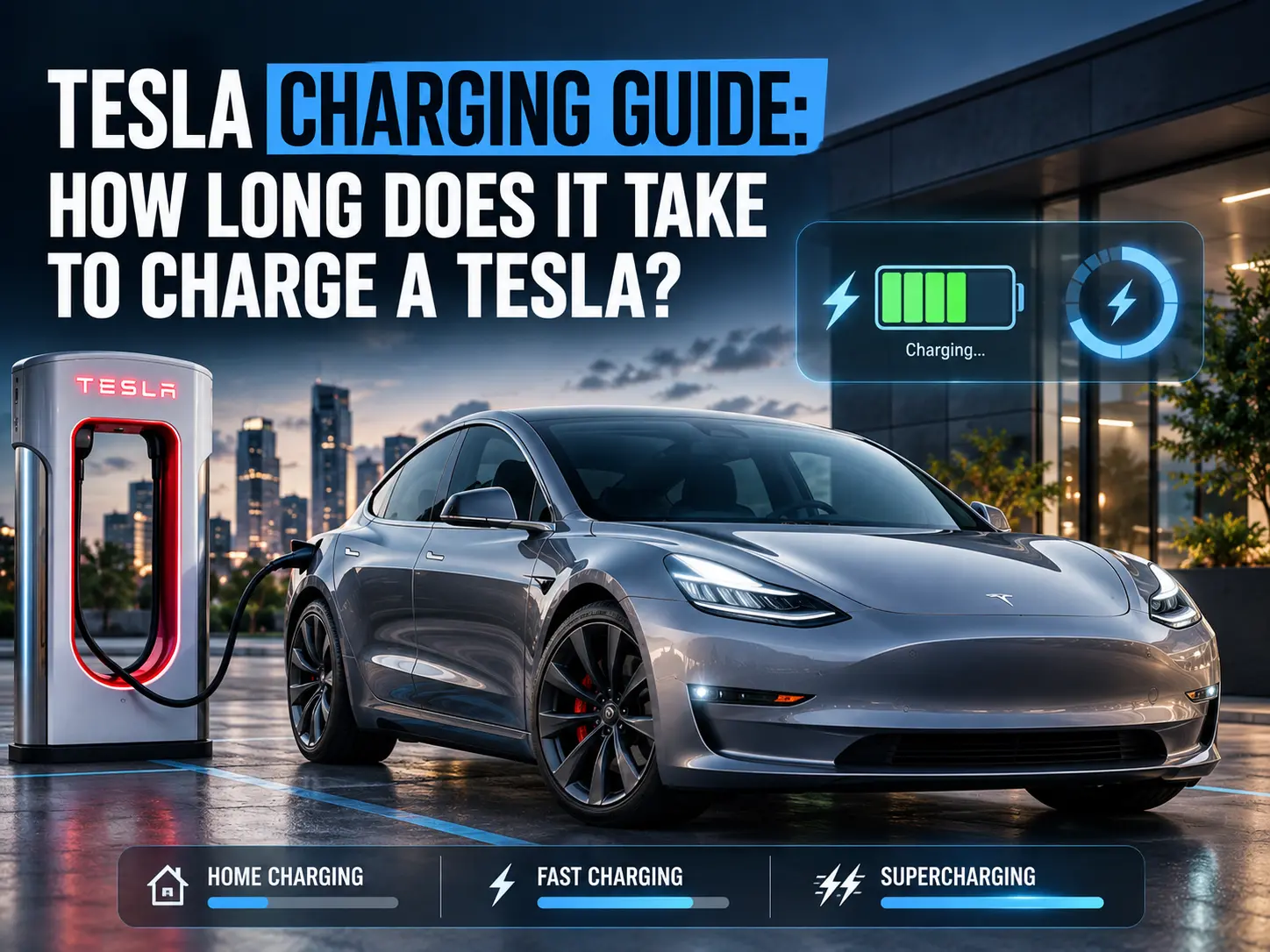
Tesla Charging Guide: How Long Does It Take to Charge a Tesla?
If you’re thinking about buying a Tesla, one of the first questions you may ask is simple: how long does it take to charge a Tesla? Unlike filling a gasoline car, charging an EV becomes something you can work into your normal routine. You can plug in at home overnight, charge while shopping, or make a quick stop at a fast charger during a road trip.
The important thing to understand is that there isn’t one charging time for every Tesla. Your charging speed depends on your model, battery level, charger type, temperature, and electrical setup.
This Tesla Charging Guide explains the main charging options and what you can realistically expect from each one.
How Long Does It Take to Charge a Tesla?
Tesla charging times can range from several hours to a relatively short fast-charging stop.
Your biggest variable is the type of charger you’re using.
| Charging Method | Typical Charging Speed | Best Use |
|---|---|---|
| Household outlet | Slow | Emergency or occasional charging |
| Level 2 home charger | Moderate to fast | Daily overnight charging |
| Public Level 2 | Moderate | Work, shopping, and longer stops |
| Tesla Supercharger | Fast | Road trips and quick charging |
These are general categories rather than guaranteed times. Your exact result can differ depending on the Tesla model, battery capacity, state of charge, temperature, and available charging power.
Tesla Charging Guide: What Determines Charging Time?
Several factors influence how quickly your Tesla can recharge.
Tesla Model and Battery
Different Tesla vehicles have different battery sizes and charging characteristics. A Model 3, Model Y, Model S, and Model X may not accept energy at exactly the same rate.
Even within the same model, battery chemistry, configuration, production year, and software can affect charging behavior.
That’s why you should check the specifications and charging recommendations for your exact Tesla rather than relying on a generic charging estimate.
Your Starting Battery Level
Your battery percentage has a major effect on charging speed.
For example, charging from 15% to 50% generally won’t behave the same way as charging from 80% to 100%.
Tesla, like other EV manufacturers, uses a charging curve. The vehicle can generally accept more power when the battery is relatively low, while charging tends to slow as the battery approaches a high state of charge.
This is why a short Supercharger stop can add a significant amount of driving range without bringing the battery anywhere near 100%.
Temperature
Battery temperature also matters.
Very cold conditions can reduce charging performance, especially at the beginning of a charging session. Extreme heat can also affect battery management.
When appropriate, preconditioning the battery before arriving at a fast charger can help prepare it for charging.
How Long Does It Take to Charge a Tesla at Home?
For most Tesla owners, home charging is one of the most convenient options.
Instead of planning a special trip to a charging station, you can plug in after driving and let the car charge while you’re asleep.
Charging From a Household Outlet
A standard household outlet can provide electricity to your Tesla, but charging is relatively slow.
This option can make sense if:
- You drive relatively few miles each day.
- You don’t have access to dedicated EV charging.
- You need a temporary charging solution.
- You want a backup charging option.
However, if you regularly drive longer distances, you may find a dedicated Level 2 charging setup much more practical.
Level 2 Home Charging
A dedicated Level 2 charger can provide substantially more charging power than a standard household outlet.
For many drivers, this is the ideal everyday arrangement. You arrive home, plug in, and allow the vehicle to replenish its battery overnight.
Your actual charging rate depends on your electrical installation, charger, Tesla model, and available power.
Why Overnight Charging Is So Convenient
You don’t necessarily need to wait beside your Tesla while it charges.
Instead, you can treat charging as part of your routine:
- Park at home.
- Plug in.
- Set your desired charging limit.
- Leave the vehicle connected.
- Start the next day with the energy you need.
This can make EV ownership feel very different from traditional refueling.
How Long Does a Tesla Take to Charge at a Supercharger?
Tesla Superchargers are designed for faster DC charging and are particularly useful when you’re traveling long distances.
Instead of waiting several hours, you can often make a relatively short stop, add a substantial amount of energy, and continue your journey.
Why Supercharging Slows Down
One common mistake is assuming that your Tesla will charge at its maximum advertised rate throughout the entire session.
It won’t.
Charging power can decrease as the battery becomes fuller. The final portion of the charge can therefore take considerably longer than the beginning.
For road trips, you often don’t need to wait until 100%.
If your navigation system shows that you have enough energy to comfortably reach the next charging location, continuing your trip may save time.
Tesla Charging Guide: Should You Charge to 100%?
For everyday driving, you generally don’t need a completely full battery.
Your ideal charging limit depends on your Tesla’s battery type and the manufacturer’s recommendations for your vehicle.
When 80% Can Be Enough
For many daily driving situations, a moderate charge provides more than enough energy.
You might choose a lower target when:
- Your commute is short.
- You have easy access to home charging.
- You drive relatively few miles each day.
- You can conveniently recharge later.
When 100% Makes Sense
A higher charge level can be useful before a long journey, especially when charging opportunities are limited.
Before setting your charging limit, check your Tesla’s current recommendations rather than applying the same rule to every model.
Tesla Charging Time During Road Trips
Long-distance travel is where understanding charging speed becomes especially valuable.
How to Plan Your Charging Stops
Your Tesla’s navigation system can help you plan charging stops along a route.
Before leaving:
- Enter your destination.
- Review recommended charging locations.
- Check expected battery levels.
- Consider weather conditions.
- Leave a reasonable range buffer.
- Allow additional time if conditions are difficult.
Shorter Charging Stops Can Save Time
Imagine you’re traveling hundreds of miles.
You could spend extra time waiting for the battery to approach 100%, or you could charge enough to comfortably reach your next destination.
Because charging slows at higher battery percentages, the second approach can often make more sense for road-trip efficiency.
How Weather Affects Tesla Charging
Cold Weather
Cold temperatures can affect both range and charging performance.
You may notice:
- Higher energy consumption.
- Reduced driving range.
- Slower initial fast charging.
- Increased energy use for cabin heating.
Preconditioning your Tesla before a charging stop can help prepare the battery when conditions require it.
Hot Weather
High temperatures can also influence energy consumption and battery thermal management.
Using air conditioning, driving at higher speeds, and operating in very hot conditions can all affect the amount of energy available for driving.
Planning with some additional range can make your journey more comfortable.
Tesla Charging Costs
Charging time is only part of the equation. You may also want to know how much it costs.
For home charging, a simple calculation is:
Electricity cost = Energy used (kWh) × Your electricity rate
Your final cost can be affected by charging losses, local electricity prices, vehicle efficiency, and your charging habits.
Supercharger pricing can vary by location and other factors, so check the current price shown for the charging location you’re using.
Common Tesla Charging Mistakes to Avoid
If you’re new to EV ownership, avoid these common mistakes:
1. Always Waiting for 100%
You don’t normally need a full battery for every trip.
2. Ignoring Weather
Cold and extreme heat can change your expected range and charging behavior.
3. Assuming Every Charger Is Equally Fast
Different chargers provide different levels of power.
4. Forgetting About the Charging Curve
Fast charging isn’t constant from beginning to end.
5. Planning With No Range Buffer
Unexpected traffic, weather, hills, or detours can increase energy consumption.
Tesla Charging Guide: Best Routine for New Owners
A simple routine can make charging much easier.
For Daily Driving
- Charge at home when convenient.
- Follow your Tesla’s recommended charging limit.
- Plug in regularly rather than waiting until the battery is extremely low.
- Consider scheduled charging if it suits your routine.
For Road Trips
- Begin with an appropriate charge level.
- Use Tesla navigation to identify charging stops.
- Monitor your estimated arrival battery percentage.
- Charge enough to reach the next practical stop.
- Consider weather and traffic before committing to a tight range plan.
FAQ: Tesla Charging Guide
How long does it take to charge a Tesla?
It can take several hours at home with slower charging equipment or substantially less time at a Tesla Supercharger. Your exact time depends on your vehicle, battery percentage, charger, temperature, and other conditions.
How long does it take to charge a Tesla at home?
With Level 2 home charging, many owners can replenish a significant portion of their daily driving needs overnight. Exact charging speed depends on the Tesla and electrical installation.
How long does a Tesla take to charge at a Supercharger?
A useful fast-charging session can often be completed in roughly 15–40 minutes, but actual times vary considerably by model, battery percentage, charger, temperature, and charging conditions.
Is it cheaper to charge a Tesla at home?
Home charging can be less expensive than public fast charging, but your actual cost depends on your local electricity rate and the charging provider.
Should you charge a Tesla to 100%?
Not necessarily. For daily driving, follow the recommended charging limit for your particular Tesla. A higher charge can be useful before longer journeys.
Does cold weather make Tesla charging slower?
Cold conditions can affect battery performance and charging speed. Preconditioning the battery before fast charging can help when appropriate.
Conclusion: Making Tesla Charging Simple
Understanding charging becomes much easier once you stop thinking of your Tesla like a gasoline car.
You don’t necessarily need to wait until the battery is empty and then recharge it completely. Instead, you can add energy whenever it fits naturally into your day.
For most owners, home Level 2 charging can provide the convenience of overnight replenishment, while Superchargers become particularly valuable when you’re traveling longer distances.
The key is to understand your Tesla’s charging behavior, pay attention to battery percentage and weather, and plan your charging around your actual driving needs.
Do you own a Tesla? Share your model, charging setup, and typical charging time in the comments. Your experience could help another new Tesla owner understand what to expect.