Tesla Model 3 vs Model Y: Which One Should You Buy in 2026?
Choosing between the Tesla Model 3 vs Model Y looks simple until you start comparing the details. Both are practical electric vehicles, both offer impressive technology, and both can work brilliantly as your everyday car. But once you consider your commute, family, cargo needs, driving style, and budget, the differences become much more important.
If you spend most of your time driving through the city, the Model 3’s lower, more aerodynamic sedan design may appeal to you. If you regularly carry passengers, groceries, luggage, pets, or sports equipment, the Model Y’s SUV shape can make everyday life considerably easier.
So, which should you buy? Let’s break down the differences that actually matter.
Tesla Model 3 vs Model Y: Quick Comparison
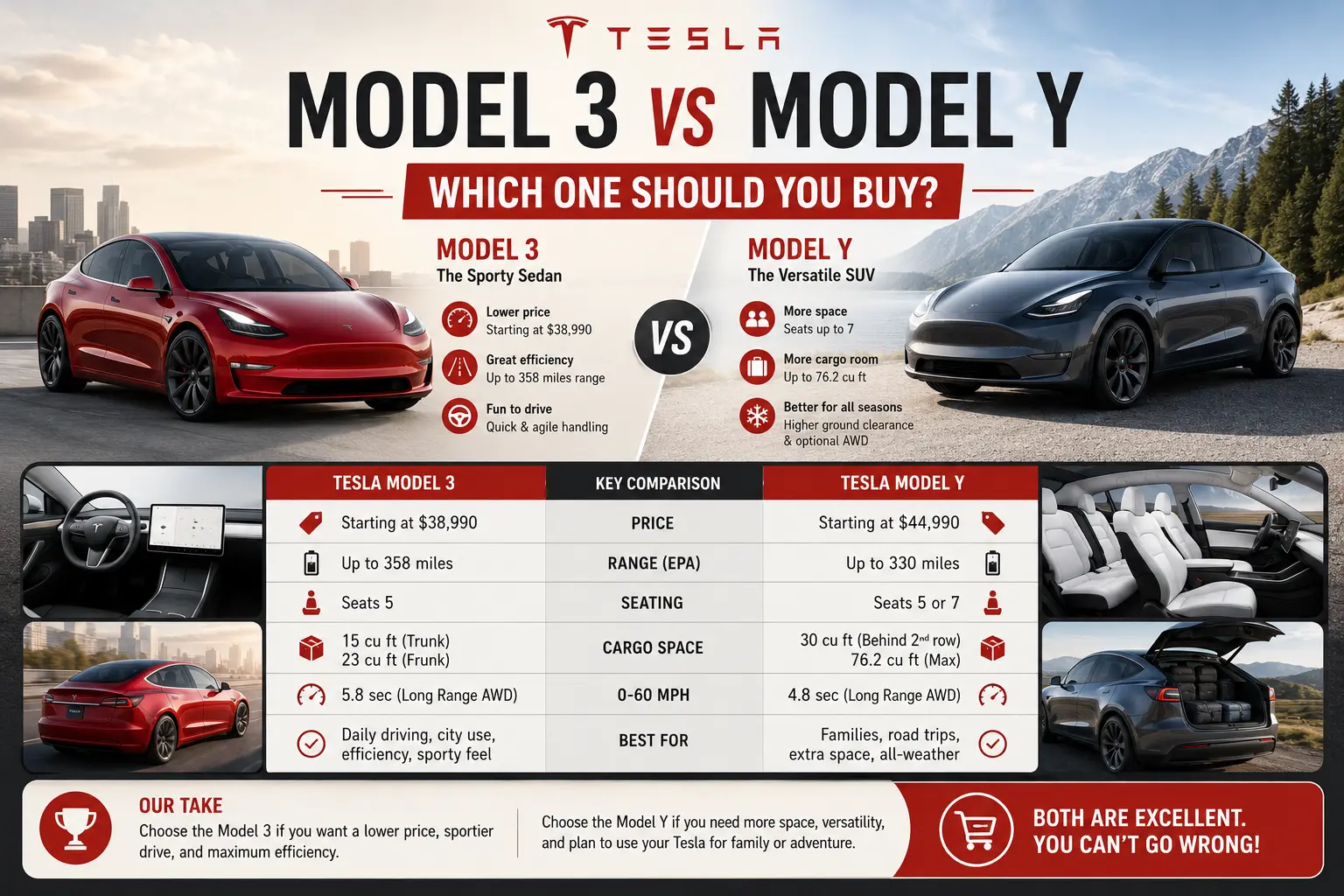
| Feature | Tesla Model 3 | Tesla Model Y |
|---|---|---|
| Body style | Sedan | Midsize SUV |
| Seating | 5 | 5 |
| Driving position | Lower | Higher |
| Cargo practicality | Good | Excellent |
| Efficiency | Generally stronger | Generally lower |
| City maneuverability | Excellent | Very good |
| Family practicality | Good | Excellent |
| Performance versions | Available | Available |
| Best suited to | Commuters | Families and versatile driving |
Tesla’s current U.S. specifications list the Model 3 at up to 321 miles of EPA-estimated range in the listed rear-wheel-drive configuration, while the Model Y page lists up to 321 miles for its current rear-wheel-drive configuration. Exact range varies by configuration and market. (Tesla)
What Is the Difference Between Tesla Model 3 and Model Y?
The simplest way to understand the Tesla Model 3 vs Model Y comparison is to think of them as two different approaches to electric driving.
The Model 3 is a sedan. It sits lower, has a more streamlined shape, and generally feels closer to a traditional sporty car.
The Model Y is a midsize SUV. You sit higher, have easier access to the cargo area, and get a more flexible cabin.
That distinction affects almost everything else.
Tesla Model 3 Is Better Suited to You If You Want:
- A lower driving position
- Strong efficiency
- Easier city parking
- Sportier sedan handling
- A smaller overall footprint
- Less need for bulky cargo space
Tesla Model Y Makes More Sense If You Need:
- More practical cargo space
- Easier passenger access
- A higher driving position
- More flexibility for family life
- Space for pets and outdoor equipment
Tesla Model 3 vs Model Y: Range and Efficiency
Range is one of the first numbers you should examine when buying an EV, but don’t make your decision based on range alone.
Tesla’s current U.S. Model 3 specifications list 321 miles of EPA-estimated range for the rear-wheel-drive model, while the Model 3 Premium is listed at up to 346 miles in the configuration shown by Tesla. (Tesla)
The current U.S. Model Y page lists 321 miles of EPA-estimated range for its rear-wheel-drive configuration. (Tesla)
The important point is that you should compare equivalent trims, not simply compare the highest number you see.
Why the Model 3 Can Be More Efficient
Its sedan shape and lower stance can help reduce aerodynamic drag. It is also generally lighter than the Model Y.
For you, that can translate into lower energy consumption during everyday driving.
However, your real-world range will depend on:
- Highway speed
- Temperature
- Wind
- Elevation
- Tires and wheels
- Heating and air conditioning
- Driving style
Tesla itself notes that actual range can vary with factors including speed, weather, and elevation. (Tesla)
Tesla Model 3 vs Model Y: Performance and Driving Experience
If you enjoy driving, don’t assume the larger Model Y automatically feels slow.
Both vehicles are available with performance-oriented configurations.
Model 3: The Sportier Choice
The Model 3’s lower center of gravity gives you a more sedan-like driving experience. It can feel particularly natural when you’re taking corners or driving on winding roads.
Tesla’s current Model 3 Performance specification lists a 2.9-second 0–60 mph time and 309 miles of EPA-estimated range. (Tesla)
That’s serious performance for a practical electric sedan.
Model Y: Performance Without Giving Up Utility
The Model Y Performance offers a different combination: SUV practicality with very rapid acceleration.
Tesla’s current Canadian specifications list the Model Y Performance at 3.5 seconds from 0–100 km/h and 494 km of EPA-estimated range. (Tesla)
So if you want an SUV but still enjoy fast acceleration, you don’t necessarily have to compromise.
Tesla Model 3 vs Model Y: Interior and Comfort
Both interiors follow Tesla’s minimalist philosophy, but the experience is different because of the body styles.
The Model 3 gives you a lower seating position and a more car-like feel. The Model Y gives you a taller seating position and easier entry.
Choose Model 3 If You Prefer:
- A lower driving position
- Sedan proportions
- A more enclosed driving feel
- A compact footprint
Choose Model Y If You Prefer:
- Easier entry and exit
- A higher view of the road
- More upright seating
- Greater cabin flexibility
Tesla currently lists a 15.4-inch center touchscreen for the Model 3 and a 16-inch center touchscreen for the Model Y in the U.S. specifications shown. (Tesla)
Tesla Model 3 vs Model Y: Cargo Space
This is one category where your lifestyle can make the decision very easy.
Tesla’s current U.S. specifications list the Model 3 with 24 cubic feet of cargo space, while the Model Y offers approximately 74 cubic feet in the configuration shown. (Tesla)
That’s a major practical difference.
Model 3 Cargo Space
The Model 3 works well for:
- Groceries
- Suitcases
- Daily shopping
- Small sports equipment
- Commuting essentials
But its sedan trunk opening limits what you can easily carry.
Model Y Cargo Space
The Model Y is much more useful if you regularly transport:
- Strollers
- Bicycles
- Camping gear
- Pets
- Large shopping loads
- Children’s equipment
If you frequently say, “I wish my car had more space,” the Model Y is probably the safer choice.
Tesla Model 3 vs Model Y for Families
For family life, the Model Y has a natural advantage.
Its SUV shape makes it easier to load children, luggage, groceries, and bulky objects. You also get a higher seating position and a large rear cargo area.
The Model 3 can absolutely work for a small family, especially if you don’t carry large amounts of equipment.
But as your family grows, the Model Y’s flexibility becomes more valuable.
Choose the Model Y If You Regularly Carry:
- Children and child seats
- Strollers
- Pets
- School bags
- Sports equipment
- Vacation luggage
For a couple or single driver, however, paying extra for SUV practicality may not be necessary.
Tesla Model 3 vs Model Y for Daily Commuting
If you’re driving to work every day, the Model 3 is particularly compelling.
Its lower profile and sedan dimensions can make it feel more natural in crowded urban environments. You may also appreciate its efficiency during long commutes.
The Model Y is still an excellent commuter, especially if you value easier entry, higher visibility, or additional cargo space.
Your choice comes down to what you do after work as much as what you do during the commute.
If your evening involves picking up children, buying groceries, taking a dog to the park, and loading equipment, the Model Y starts earning its extra practicality.
Tesla Model 3 vs Model Y: Charging and Road Trips
Both vehicles benefit from Tesla’s charging ecosystem, but your road-trip experience will depend on the exact battery and configuration.
Tesla’s current Model 3 Performance specification lists up to 162 miles of range added in 15 minutes under its stated testing conditions, while the Model Y specifications list up to 160 miles added in 15 minutes for the rear-wheel-drive configuration. (Tesla)
Remember that these figures aren’t guarantees for every charging stop. Battery temperature, state of charge, charger type, driving conditions, and other factors affect charging.
Which Is Better for Road Trips?
Choose Model 3 if you prioritize efficiency and don’t need lots of cargo.
Choose Model Y if you prioritize passenger comfort, luggage capacity, and versatility.
Tesla Model 3 vs Model Y: Ownership and Maintenance
Neither car requires traditional engine maintenance because neither has a gasoline engine.
You won’t need conventional:
- Oil changes
- Spark plugs
- Engine air filters
- Traditional engine tune-ups
You still need to budget for tires, brake inspections, cabin filters, wipers, and other normal vehicle maintenance.
Tesla’s current U.S. pages list a four-year/50,000-mile basic vehicle warranty for both the Model 3 and Model Y configurations shown, although coverage can differ by market and vehicle configuration. (Tesla)
Tire costs deserve particular attention. Larger wheels and performance versions can increase replacement costs, so consider the complete ownership picture rather than only the purchase price.
Tesla Model 3 vs Model Y: Which One Is Better for You?
Here’s the simplest decision guide.
| Your Priority | Better Choice |
|---|---|
| Daily commuting | Model 3 |
| Maximum practicality | Model Y |
| Sedan driving feel | Model 3 |
| Family use | Model Y |
| Bulky cargo | Model Y |
| Easy city maneuvering | Model 3 |
| Higher seating position | Model Y |
| Sportier feel | Model 3 |
| Performance SUV | Model Y Performance |
| Small household | Model 3 |
| Growing family | Model Y |
Choose Tesla Model 3 If You:
- Mostly drive alone or with one passenger
- Want excellent efficiency
- Prefer sedan handling
- Don’t regularly carry bulky cargo
- Want a smaller vehicle
- Enjoy sporty driving
Choose Tesla Model Y If You:
- Have children
- Carry passengers frequently
- Need significant cargo space
- Prefer an SUV
- Carry pets or outdoor equipment
- Take family road trips
Common Mistakes When Choosing Between Model 3 and Model Y
Comparing Different Trims
Don’t compare a base Model 3 with a Performance Model Y and conclude that the vehicles themselves are fundamentally different.
Compare equivalent configurations whenever possible.
Looking Only at Range
Your actual range depends on your driving conditions. A slightly lower official range may be perfectly adequate for your daily routine.
Ignoring Cargo Needs
If you regularly transport bulky items, test the Model 3 and Model Y in person. Bring the stroller, luggage, or equipment you normally use.
Forgetting Home Charging
Before buying either Tesla, consider where you’ll charge overnight and how much you drive each day.
Frequently Asked Questions About Tesla Model 3 vs Model Y
Is Tesla Model 3 better than Model Y?
Neither is universally better. The Model 3 is generally the better fit if you prioritize efficiency, sedan handling, and commuting. The Model Y is stronger for space and versatility.
Which is better, Tesla Model 3 vs Model Y for families?
The Model Y is usually the better family choice because its SUV body provides easier loading and substantially greater cargo flexibility.
Which has better range, Model 3 or Model Y?
It depends on the exact configuration and market. Tesla currently lists up to 346 miles EPA-estimated range for the Model 3 Premium configuration shown, while the current Model Y rear-wheel-drive specification is listed at 321 miles. (Tesla)
Is Tesla Model 3 cheaper than Model Y?
Pricing changes frequently and varies by market and configuration. Check Tesla’s current local configurator rather than relying on an old price.
Which is faster, Model 3 or Model Y?
The Model 3 Performance is currently listed at 2.9 seconds from 0–60 mph, while the Model Y Performance is listed at 3.5 seconds from 0–100 km/h on Tesla’s Canadian site. Testing standards differ, so compare equivalent measurements carefully. (Tesla)
Which Tesla is better for road trips?
The Model 3 can be excellent for efficient long-distance travel, while the Model Y is better if you need more passenger and cargo space.
Conclusion: Tesla Model 3 vs Model Y — Which Should You Buy?
The Tesla Model 3 vs Model Y decision ultimately comes down to how you live.
If you want a sleek, efficient, easy-to-drive sedan and don’t need a huge cargo area, Model 3 is likely the smarter choice. Its efficiency, performance options, and compact dimensions make it an excellent everyday EV.
If you want one vehicle that can handle children, luggage, pets, groceries, road trips, and weekend adventures, Model Y is probably worth the extra practicality.
Before you make your decision, compare the exact versions available in your market, calculate your charging requirements, check insurance and tire costs, and take both vehicles for a test drive.
Which would you choose—the efficient and sporty Model 3 or the spacious and versatile Model Y? Tell us which Tesla fits your lifestyle and why.