Tesla Batteries: How Long Do They Last? A Complete Guide for 2026
Buying an electric car often comes with one question that is difficult to ignore: how long will the battery actually last?
If you’re considering a Tesla, you may be impressed by the acceleration, quiet cabin, low routine maintenance, and convenience of charging at home. But the battery is also one of the vehicle’s most important and expensive components. Naturally, you want to know whether your Tesla battery will still be useful after years of driving.
The good news is that Tesla batteries don’t have a fixed expiration date. They gradually lose some capacity as they age, but degradation is different from sudden battery failure. Your climate, mileage, charging habits, battery chemistry, and driving patterns all influence the result.
Here is what you should know before buying or owning a Tesla.
How Long Do Tesla Batteries Last?
There isn’t one mileage or year figure that applies to every Tesla battery.
Battery lifespan depends on several factors:
- Battery chemistry
- Tesla model and configuration
- Climate
- Mileage
- Charging habits
- Time
- Driving conditions
- How frequently the battery is deeply discharged
The most useful distinction is between battery degradation and battery failure.
Degradation means the battery gradually holds less energy than it did when new. Failure is a malfunction that prevents the battery from operating correctly.
A Tesla can experience some capacity loss while remaining perfectly useful for many years.
What Happens as Tesla Batteries Age?
You may gradually notice that your vehicle’s maximum estimated range is lower than it was when new. That doesn’t necessarily mean something is wrong.
For example, if your battery originally delivered 300 miles under comparable conditions and later provided 270 miles, that represents roughly 10% less capacity.
The important point is that degradation isn’t usually an overnight event.
Tesla Battery Degradation Explained
What Is Battery Degradation?
Tesla batteries use rechargeable lithium-ion technology. Like other lithium-ion batteries, they experience chemical aging.
Two concepts are particularly useful:
Calendar aging: capacity loss associated with time.
Cycle aging: capacity loss associated with battery usage and charge/discharge cycles.
Your battery experiences both.
Temperature, state of charge, charging behavior, and battery chemistry can influence how quickly these processes occur.
Is Battery Degradation Normal?
Yes.
Some degradation is expected as a battery ages. You shouldn’t interpret every small reduction in estimated range as evidence of battery failure.
Tesla itself warns that the vehicle’s displayed range is an imperfect measurement of battery capacity because range estimates are influenced by factors beyond the battery’s actual capacity. (Cloudinary)
How Many Miles Can Tesla Batteries Last?
You may see claims online suggesting that every Tesla battery lasts a specific number of miles. Be careful with those statements.
There isn’t a universal mileage at which Tesla batteries suddenly stop working.
| Mileage | What You Should Consider |
|---|---|
| 50,000 miles | Still relatively early in the vehicle’s life |
| 100,000 miles | Important when evaluating warranty coverage |
| 150,000 miles | Battery condition becomes increasingly relevant |
| 200,000+ miles | Individual battery history matters greatly |
Two Teslas with 150,000 miles can have different battery conditions because their owners may have driven them in completely different environments and used different charging routines.
Why Mileage Isn’t Everything
When you’re buying a used Tesla, look beyond the odometer.
Consider:
- Battery condition
- Remaining warranty
- Climate history
- Charging habits
- Vehicle history
- Current estimated range
- Service records
Tesla Battery Warranty: How Much Protection Do You Get?
Warranty coverage is one of the strongest reasons to understand the exact Tesla you’re buying.
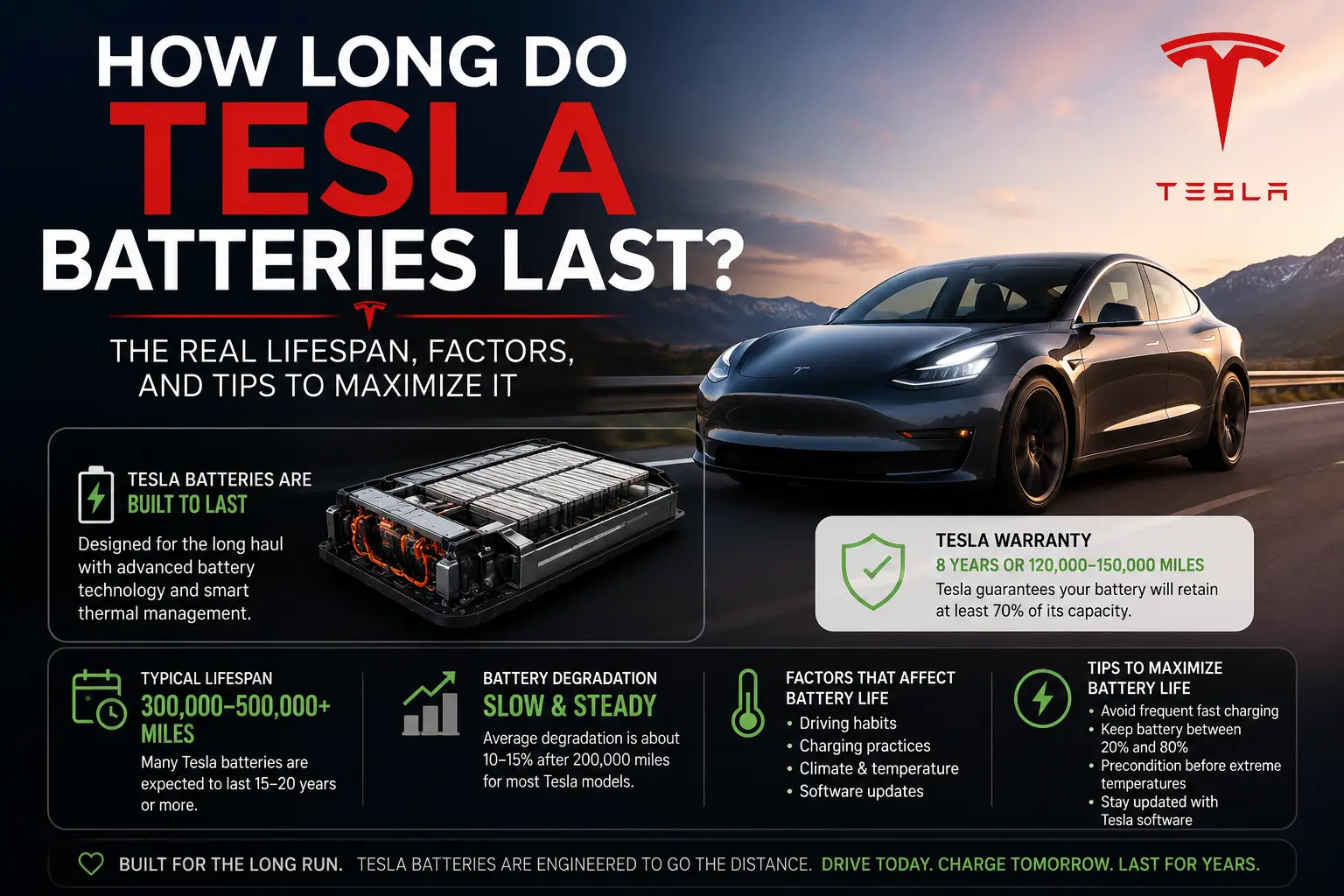
Tesla’s current warranty page lists different Battery and Drive Unit coverage depending on model and configuration. In the U.S., current examples range from 8 years/100,000 miles to 8 years/150,000 miles, with a minimum 70% battery-capacity retention during the applicable warranty period. (Tesla)
Tesla’s Morocco support page currently lists battery and drive-unit coverage of 8 years/160,000 km for certain Model 3 RWD and Model Y RWD configurations and 8 years/192,000 km for several Premium Long Range and Performance configurations, each with the 70% capacity-retention provision. (Tesla)
That distinction matters because you shouldn’t copy a warranty figure from another country and assume it applies to your vehicle.
Does the Eight-Year Warranty Mean the Battery Dies After Eight Years?
No.
The warranty period is a period of manufacturer coverage. It isn’t an expiration date.
Your Tesla battery can remain usable after the warranty expires. The question becomes how much capacity remains and whether the battery continues to meet your driving needs.
Tesla Batteries: LFP vs. Nickel-Based Chemistry
Not all Tesla batteries are identical.
Depending on the model and configuration, Tesla has used different battery chemistries, including lithium iron phosphate (LFP) and nickel-based chemistries.
LFP Batteries
LFP batteries are known for strong cycle-life characteristics and have different charging considerations from some nickel-based batteries.
Nickel-Based Batteries
Nickel-based chemistries can offer high energy density and are used in various EV applications.
Why Battery Chemistry Matters
You shouldn’t follow a generic charging rule simply because someone recommends it online.
Tesla specifically says that different batteries require different charging routines and that your vehicle’s touchscreen displays the recommended charge limit for your battery. (Tesla)
That makes your own Tesla’s charging recommendation more useful than a universal internet rule.
What Causes Tesla Battery Degradation?
Several factors can influence battery aging.
High Temperatures
Extreme heat can accelerate battery aging. If you live in a hot climate, managing battery temperature and following Tesla’s charging guidance becomes particularly important.
Cold Weather
Cold temperatures can temporarily reduce available range and charging performance.
That’s different from permanent battery degradation.
You may see lower range during a cold period and then recover much of that performance when temperatures return to normal.
Staying at Very High or Very Low Charge
Tesla recommends avoiding leaving the vehicle near 0% or 100% for days or weeks at a time. For vehicles with an 80% recommended daily limit, Tesla advises keeping that limit for everyday use and increasing it when necessary for longer trips. (Tesla)
Frequent Deep Discharges
Regularly allowing the battery to become extremely low before charging isn’t an ideal everyday routine.
Tesla recommends charging frequently rather than repeatedly allowing the battery to discharge to a low state of charge. (Tesla)
Fast Charging
Supercharging is a normal Tesla charging method, particularly useful for road trips. However, your overall charging pattern and battery temperature still matter.
You shouldn’t assume that using a Supercharger occasionally means you’re damaging your battery.
How to Make Your Tesla Battery Last Longer
You don’t need to obsess over every percentage point. A few sensible habits can help.
Follow These Tesla Battery Care Practices
- Follow the charge limit recommended for your specific battery.
- Avoid leaving your Tesla near 0% or 100% for extended periods.
- Charge regularly rather than repeatedly running very low.
- Use home charging when practical.
- Reserve fast charging primarily for trips when it suits your routine.
- Avoid prolonged exposure to extreme temperatures when possible.
- Use Tesla’s battery and charging features as recommended.
- Check the vehicle’s own charging guidance rather than relying on generic advice.
Tesla recommends charging where you park and says its Wall Connector is designed for convenient home charging. (Tesla)
How Can You Check Tesla Battery Health?
This is especially important if you’re purchasing a used Tesla.
Check Your Estimated Range
You can monitor the vehicle’s estimated range over time, but don’t treat that number as a laboratory-grade battery-health measurement.
Your displayed range can be affected by driving conditions and efficiency.
Look for Warning Messages
Pay attention to:
- Battery warnings
- Unexpected charging interruptions
- Sudden unexplained range changes
- Significant changes in charging behavior
- Unusual performance problems
If something changes suddenly, professional diagnosis is more useful than guessing from the range display.
Consider Professional Battery Testing
When buying a used Tesla, an independent battery-health report can provide additional information if one is available from a reputable EV specialist.
Signs Your Tesla Battery May Have a Problem
Normal degradation is gradual.
A sudden change deserves more attention.
Contact Tesla Service or a qualified EV professional if you experience:
- Unexpected battery warnings
- Major unexplained range loss
- Charging failures
- Repeated charging interruptions
- Significant changes in battery performance
Don’t diagnose a battery failure simply because the estimated range has decreased.
How Much Does Tesla Battery Replacement Cost?
This is where many online articles become misleading.
There is no single Tesla battery replacement price.
The final cost can depend on:
- Tesla model
- Battery configuration
- Pack availability
- Labor
- Location
- Warranty coverage
- Whether repair or replacement is appropriate
Tesla’s warranty documentation states that, when a covered battery requires repair or replacement, Tesla may repair it or replace it with a new, reconditioned, or remanufactured component at Tesla’s discretion. (Cloudinary)
Therefore, don’t assume you’ll automatically receive an entirely new battery pack.
Can Battery Modules Be Repaired?
Depending on the vehicle and fault, repairs may involve components rather than replacing the entire pack.
Your safest approach is to obtain a diagnosis from Tesla Service or a qualified EV battery specialist before assuming that the entire battery needs replacement.
Tesla Batteries in Used Cars: What Should You Check?
If you’re shopping for a used Tesla, battery condition should be part of your inspection.
Your Used-Tesla Battery Checklist
- Current mileage
- Remaining battery warranty
- Estimated range
- Charging behavior
- Warning messages
- Accident history
- Service history
- Battery-health report, if available
- Vehicle configuration
- Purchase price
A Tesla with some degradation isn’t automatically a bad purchase.
Instead, ask whether the battery’s current condition is appropriate for the price and the driving you expect to do.
Tesla Battery Life vs. Gasoline Engine Life
Comparing a battery directly with a gasoline engine isn’t entirely straightforward.
| Factor | Tesla Battery | Gasoline Engine |
|---|---|---|
| Aging mechanism | Chemical degradation | Mechanical wear |
| Oil changes | No | Yes |
| Routine engine service | Minimal | More extensive |
| Capacity/performance changes | Gradual | Can vary |
| Major repair | Potentially expensive | Potentially expensive |
Tesla says its vehicles require minimal routine maintenance and don’t need traditional oil changes, while regenerative braking can reduce brake wear. (Tesla)
That doesn’t mean a Tesla is maintenance-free. Tires, brakes, filters, wipers, suspension components, and other items still require attention.
Tesla Battery Myths You Should Ignore
Myth 1: Every Tesla Battery Dies at 100,000 Miles
There’s no universal expiration point at 100,000 miles.
Myth 2: Supercharging Automatically Ruins Tesla Batteries
Supercharging is a supported Tesla charging method. Battery aging depends on multiple factors rather than one charging method alone.
Myth 3: Any Range Loss Means Battery Failure
Gradual capacity loss is normal. A sudden or unusually large change deserves investigation.
Myth 4: Every Tesla Must Be Charged the Same Way
Tesla specifically notes that charging recommendations differ by battery type. Follow your vehicle’s displayed recommendation. (Tesla)
Frequently Asked Questions About Tesla Batteries
How long do Tesla batteries last?
There is no universal lifespan. Your Tesla battery can remain useful for many years, with gradual degradation influenced by mileage, chemistry, climate, and charging habits.
How many miles can Tesla batteries last?
There is no guaranteed mileage limit for the battery’s usable life. Warranty coverage provides a more concrete benchmark, while actual lifespan depends on the individual vehicle.
Do Tesla batteries need to be replaced after eight years?
No. Eight years refers to the applicable warranty period, not an automatic battery expiration date.
How much does it cost to replace a Tesla battery?
It varies by model, battery pack, labor, location, and whether the repair is covered by warranty. Get a specific diagnostic estimate rather than relying on a generic internet price.
Does Supercharging damage Tesla batteries?
Supercharging is designed for Tesla vehicles and is particularly useful for long-distance travel. Battery health depends on your overall usage and charging conditions.
How can you make Tesla batteries last longer?
Follow the charge limit recommended for your specific battery, avoid leaving the vehicle near 0% or 100% for extended periods, and follow Tesla’s current charging guidance.
How do you check Tesla battery health?
Monitor range and charging behavior, but remember that displayed range isn’t a precise battery-capacity test. For serious concerns or a used-car purchase, consider professional diagnostics.
Conclusion: Tesla Batteries Can Last Longer Than You Think
The biggest mistake you can make when researching Tesla Batteries is looking for one magic number.
There isn’t one.
Your battery’s useful life depends on its chemistry, model, climate, mileage, charging habits, and how you use the vehicle. Some capacity loss is normal, but degradation doesn’t mean your Tesla suddenly becomes unusable.
If you’re buying a Tesla, look at the battery warranty, charging requirements, expected mileage, and long-term ownership costs. If you’re buying used, inspect the battery condition and remaining warranty rather than judging the vehicle solely by its age or odometer.
And if you already own a Tesla, don’t obsess over every mile shown on the range display. Follow Tesla’s recommendations, charge sensibly, and investigate sudden changes instead of assuming the worst.
Thinking about buying a Tesla? Check the battery warranty for your exact model, review your charging routine, and compare the vehicle’s current condition with your expected driving needs. If you’re considering a used Tesla, ask for battery-health information before you make an offer—and share your Tesla model and mileage in the comments so other readers can compare real-world ownership experiences.