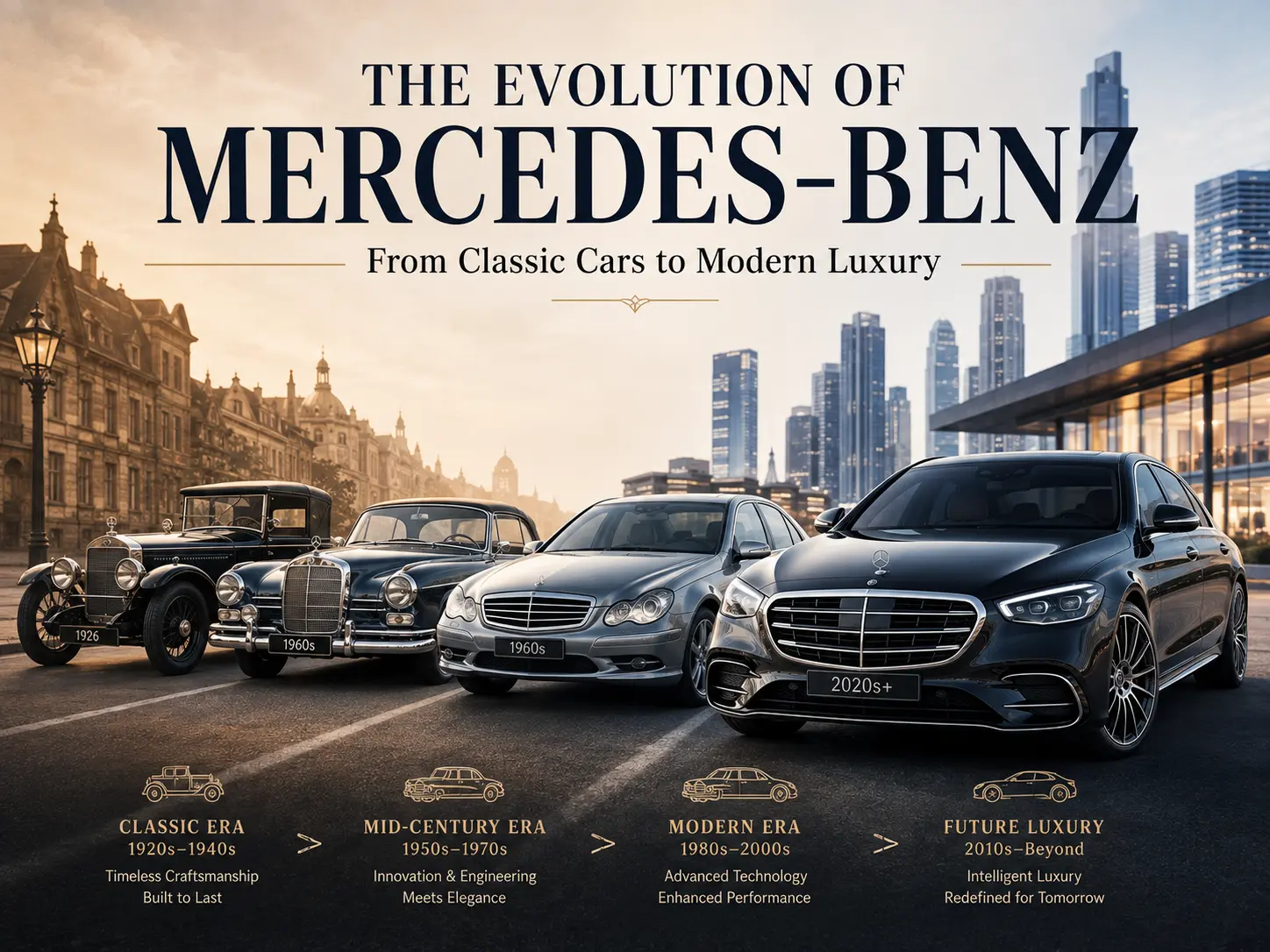
The Evolution of Mercedes-Benz: From Classic Cars to Modern Luxury
When you see a modern Mercedes-Benz gliding quietly down the road, it can be easy to forget how different the automobile looked more than a century ago. Today’s models combine luxury interiors, digital technology, advanced safety systems, hybrid powertrains, and electric propulsion. Yet the story behind them began with a much simpler idea: creating a machine capable of moving people without horses.
The evolution of Mercedes-Benz is therefore more than a history of changing car designs. It is a story of engineering ambition, luxury, safety, performance, and constant reinvention. As you explore the brand’s journey, you’ll see how classic Mercedes-Benz models helped create the foundation for the sophisticated vehicles you can drive today.
The Birth of Mercedes-Benz and the Automobile
Karl Benz and the First Automobile
The story begins in the late 19th century with Karl Benz. In 1886, Benz patented his three-wheeled Benz Patent-Motorwagen, widely recognized as one of the first practical automobiles powered by an internal-combustion engine.
This invention changed transportation forever.
Rather than simply developing another carriage, Benz created a purpose-built motor vehicle. His work demonstrated that personal transportation could eventually move beyond animal power.
Bertha Benz’s Historic Journey
Bertha Benz played an important role in proving the automobile’s practical potential. In 1888, she undertook a long-distance journey in one of her husband’s vehicles.
Her trip demonstrated that automobiles could be used outside the immediate area around their creators. It also highlighted practical improvements that would be important for future vehicle development.
This early combination of experimentation and real-world problem solving became an important part of the Mercedes-Benz story.
How the Mercedes-Benz Name Was Created
The history becomes more complicated because Benz and Daimler initially operated as separate companies.
The Mercedes Name
Emil Jellinek, a prominent Daimler customer and motorsport enthusiast, became closely associated with the Mercedes name in the early 1900s. The Mercedes 35 hp, introduced in 1901, represented a significant step toward the modern automobile with its advanced layout and performance.
The name eventually became part of a much larger automotive identity.
Mercedes-Benz Is Established
In 1926, Benz & Cie. and Daimler-Motoren-Gesellschaft merged to form Daimler-Benz AG. The Mercedes-Benz brand was born from this union.
From this point forward, the company could combine the engineering traditions associated with both pioneers.
The Evolution of Mercedes-Benz Design and Engineering
During the following decades, Mercedes-Benz increasingly focused on combining performance with comfort and sophisticated engineering.
Early luxury models introduced improvements in areas such as:
- Engine performance
- Suspension
- Braking
- Body construction
- Passenger comfort
- Aerodynamics
The automobile was becoming more than a basic transportation device. It was evolving into a carefully engineered machine designed around the driver and passengers.
Mercedes-Benz and Aerodynamic Design
Mercedes-Benz also experimented with streamlined bodywork and aerodynamic principles.
This mattered because reducing aerodynamic resistance could contribute to improved performance and efficiency while also influencing high-speed stability.
Many ideas tested in motorsport and advanced engineering programs eventually influenced road-going vehicles.
Classic Mercedes-Benz Models That Defined an Era
Mercedes-Benz 300 SL Gullwing
Few classic Mercedes-Benz models are as instantly recognizable as the 300 SL.
Its famous gullwing doors immediately made it visually distinctive, but the car’s importance went far beyond styling. The 300 SL incorporated advanced engineering and became one of the defining sports cars of the 1950s.
For you as a modern enthusiast, the 300 SL remains a reminder that Mercedes-Benz’s interest in performance and innovation didn’t begin with today’s AMG models.
Mercedes-Benz 600
The Mercedes-Benz 600 represented another side of the brand.
Rather than focusing primarily on sports-car performance, it emphasized extraordinary luxury, comfort, and engineering sophistication. Its large proportions, premium interior, and complex systems made it a flagship automobile.
Mercedes-Benz W123
The W123 became particularly respected for its combination of durability, comfort, and engineering.
It was offered with several gasoline and diesel engines and became popular with private owners and professional drivers alike.
Its reputation demonstrates an important aspect of Mercedes-Benz history: luxury and practicality could exist in the same vehicle.
Mercedes-Benz Safety Innovation
Safety became one of the most important chapters in the evolution of Mercedes-Benz.
From Passive Protection to Active Assistance
Mercedes-Benz invested heavily in occupant protection and vehicle safety.
Over the decades, developments included technologies and engineering concepts involving:
- Crumple zones
- Improved passenger protection
- Anti-lock braking systems
- Airbags
- Electronic stability systems
- Advanced driver assistance
Why Safety Changed the Industry
Instead of treating safety as an afterthought, manufacturers increasingly designed vehicles around protecting occupants before, during, and after a collision.
That philosophy continues in today’s Mercedes-Benz vehicles, although modern systems are far more sophisticated than those found in classic cars.
The Rise of Mercedes-Benz AMG
Performance became another defining part of Mercedes-Benz’s identity.
From Motorsport to AMG
AMG began as an independent performance company founded by Hans Werner Aufrecht and Erhard Melcher.
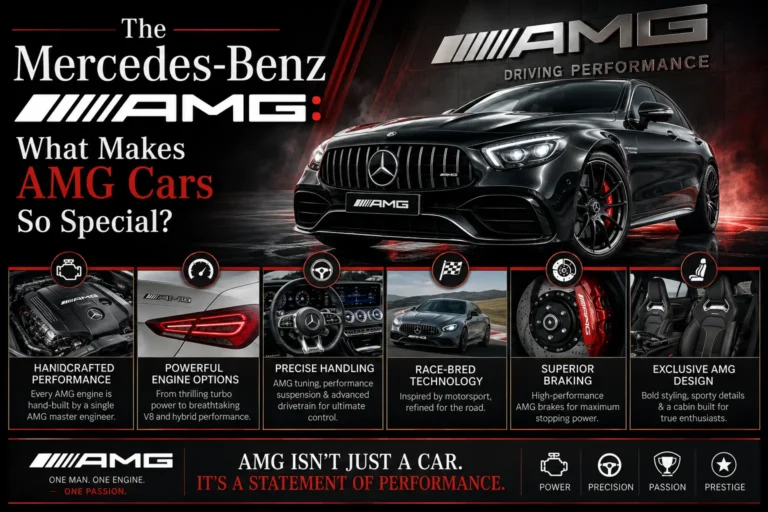
Its reputation grew through motorsport and high-performance Mercedes-Benz tuning. Eventually, AMG became integrated into the Mercedes-Benz organization, creating the Mercedes-AMG performance brand you know today.
Modern AMG vehicles combine:
- Powerful engines
- Performance-oriented transmissions
- Sport-tuned suspension
- Larger brakes
- Aggressive styling
- Advanced electronics
From Classic Performance to Modern AMG
The journey from early AMG tuning projects to today’s sophisticated AMG models demonstrates how motorsport expertise became part of Mercedes-Benz’s broader performance identity.
Mercedes-Benz Luxury and Interior Evolution
The interior of a modern Mercedes-Benz is dramatically different from a cabin from the 1960s or 1970s.
Classic vehicles often emphasized:
- Analog gauges
- Physical switches
- Wood trim
- Leather
- Mechanical controls
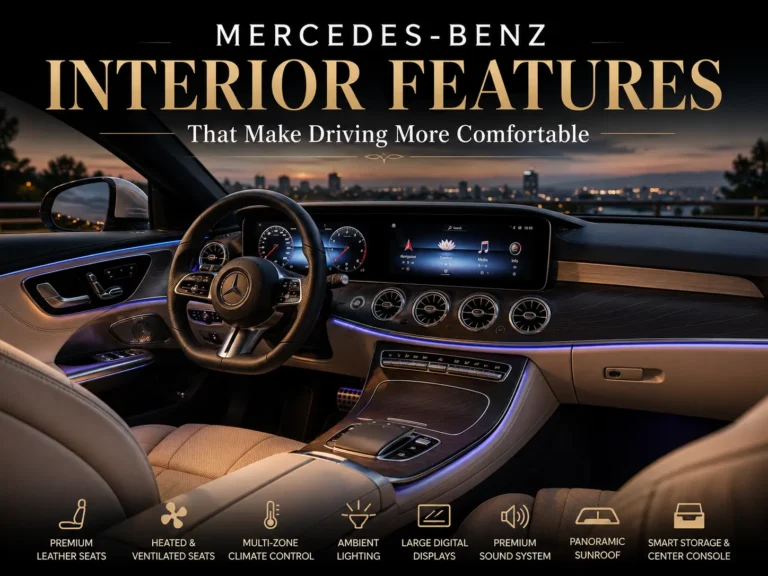
Modern Mercedes-Benz vehicles can offer:
- Large digital displays
- Ambient lighting
- Advanced climate control
- Voice interaction
- Smartphone integration
- Premium audio
- Electrically adjustable seating
The S-Class as a Technology Leader
The Mercedes-Benz S-Class has frequently served as a showcase for new technology.
Features introduced or refined in flagship Mercedes-Benz models have often influenced technology across the broader automotive industry.
This makes the S-Class particularly important when you’re studying the evolution of Mercedes-Benz luxury.
The Evolution of Mercedes-Benz SUVs
Mercedes-Benz eventually expanded beyond traditional sedans and sports cars.
The Mercedes-Benz G-Class
The G-Class began with rugged off-road ambitions. Over time, it developed into something unusual: an SUV that could combine serious off-road capability with luxury.
Its boxy silhouette has remained remarkably recognizable despite decades of technological changes.
GLE, GLC, and GLS
As SUV demand increased, Mercedes-Benz expanded its range with models such as the GLC, GLE, and GLS.
These vehicles give you choices ranging from compact luxury SUVs to large three-row models.
They also demonstrate how Mercedes-Benz adapted its traditional luxury philosophy to changing customer preferences.
Mercedes-Benz Enters the Digital Age
MBUX and Connected Technology
One of the biggest transformations has occurred inside the cabin.
Mercedes-Benz User Experience, commonly known as MBUX, brings together infotainment, navigation, vehicle settings, voice interaction, and connectivity.
Depending on the model, you can also find:
- Digital instrument displays
- Touchscreen controls
- Smartphone connectivity
- Voice commands
- Connected services
- Advanced navigation
The modern Mercedes-Benz is increasingly defined by software as well as mechanical engineering.
The Evolution Toward Electric Mercedes-Benz Models
Electrification represents another major turning point.
Modern Mercedes-Benz electric vehicles use battery power, regenerative braking, sophisticated software, and dedicated electric-vehicle technologies.
What Electric Power Changes
Compared with traditional combustion engines, electric vehicles can provide:
- Instant torque
- Quieter operation
- Reduced tailpipe emissions
- Different cabin packaging possibilities
- New approaches to vehicle software
The transition to electric mobility demonstrates that Mercedes-Benz continues to adapt as transportation technology changes.
Classic vs Modern Mercedes-Benz
| Feature | Classic Mercedes-Benz | Modern Mercedes-Benz |
|---|---|---|
| Instruments | Analog | Digital |
| Controls | Mostly physical | Touch, buttons and voice |
| Powertrains | Gasoline/diesel | Gasoline, hybrid and electric |
| Safety | Mainly passive | Passive + active assistance |
| Infotainment | Radio | Connected digital systems |
| Interior | Wood, leather, mechanical details | Digital displays and premium materials |
| Lighting | Conventional | Advanced LED systems |
| Connectivity | Limited | Smartphone and connected services |
The biggest difference isn’t simply age. It’s the amount of technology surrounding you.
What Has Stayed the Same?
Despite dramatic changes, several themes remain recognizable.
Mercedes-Benz continues to emphasize:
- Engineering
- Comfort
- Performance
- Safety
- Luxury
- Innovation
A 1950s 300 SL and a modern Mercedes-AMG may look completely different, but both reflect the company’s long-standing interest in combining engineering with an emotional driving experience.
The Future of Mercedes-Benz
The next chapter is likely to be increasingly shaped by electrification and software.
You can expect continued development in areas such as:
- Battery-electric vehicles
- Charging technology
- Energy efficiency
- Digital interfaces
- Connected services
- Driver assistance
- Vehicle software
The automobile is becoming increasingly connected, and Mercedes-Benz is positioning itself for that transition.
FAQ: The Evolution of Mercedes-Benz
When did Mercedes-Benz begin?
The modern Mercedes-Benz company was established in 1926 through the merger of Benz & Cie. and Daimler-Motoren-Gesellschaft. However, its history reaches back to the pioneering automobile work of Karl Benz and Gottlieb Daimler in the 1880s.
What is the most famous classic Mercedes-Benz?
The 300 SL Gullwing is one of the most famous classic Mercedes-Benz models, thanks to its distinctive design, engineering, and motorsport connections.
How has Mercedes-Benz changed over the years?
Mercedes-Benz has evolved from producing mechanically focused automobiles into creating luxury vehicles that combine sophisticated engineering with advanced safety, digital technology, connectivity, electrification, and driver assistance.
What role did AMG play in Mercedes-Benz history?
AMG helped establish Mercedes-Benz as a major performance-car manufacturer. Its motorsport background and performance engineering eventually became an integral part of the Mercedes-AMG brand.
Why is the Mercedes-Benz S-Class important?
The S-Class has frequently served as a flagship for Mercedes-Benz technology, luxury, safety, and comfort. It has helped establish features and concepts that later appeared elsewhere in the automotive industry.
Is modern Mercedes-Benz better than classic Mercedes-Benz?
It depends on what you value. Modern Mercedes-Benz vehicles generally provide substantially more technology, safety, efficiency, and comfort. Classic models, however, offer distinctive mechanical character, historical significance, and styling that many enthusiasts find difficult to replicate.
Conclusion: The Evolution of Mercedes-Benz Continues
The evolution of Mercedes-Benz stretches from Karl Benz’s pioneering automobile to today’s digitally connected luxury and electric vehicles.
Along the way, the company created legendary models, advanced automotive safety, developed high-performance AMG vehicles, expanded into SUVs, transformed interior design, and embraced electrification.
When you look at a modern Mercedes-Benz, you’re seeing more than a luxury car. You’re seeing the result of more than a century of experimentation and engineering.
And that’s what makes the brand’s history so fascinating: the cars keep changing, but the pursuit of innovation never really stops.
Which era of Mercedes-Benz do you prefer—the classic 300 SL, legendary W123, AMG performance era, or today’s high-tech models? Share your favorite Mercedes-Benz and tell us what makes it special to you.