Mercedes-Benz AMG: What Makes AMG Cars So Special?
There is something different about driving a Mercedes-AMG. You notice it when you press the accelerator, turn into a corner, or hear the engine come alive. It is not simply about getting from one destination to another. You feel as though the car is responding directly to you.
That feeling is what makes Mercedes-Benz AMG so appealing.
AMG combines Mercedes-Benz luxury with performance-focused engineering, distinctive design, advanced chassis technology, and a long motorsport history. Today, the AMG range includes sedans, coupes, SUVs, roadsters, and high-performance electric models.
But what actually separates an AMG from an ordinary Mercedes-Benz? And is an AMG worth the extra money? Let’s take a closer look.
What Is Mercedes-Benz AMG?
AMG began in 1967 when Hans Werner Aufrecht and Erhard Melcher established a performance engineering company. Its motorsport success helped build the reputation that eventually developed into today’s Mercedes-AMG brand.
Mercedes-AMG is now a wholly owned subsidiary of Mercedes-Benz Group AG and operates from Affalterbach, Germany. Mercedes-AMG describes its core development philosophy through four areas: drive systems, driving dynamics, sound, and design.
That combination is important. An AMG is not simply a Mercedes-Benz with a more powerful engine.
What Makes Mercedes-AMG Cars Different?
When you compare a standard Mercedes-Benz with a genuine AMG performance model, the differences can extend throughout the vehicle.
You may find:
- AMG-specific powertrains
- Performance-oriented transmissions
- Specialized suspension tuning
- High-performance brakes
- AMG steering systems
- Performance-focused aerodynamics
- Distinctive AMG exterior styling
- Sportier interior equipment
- Additional driving modes
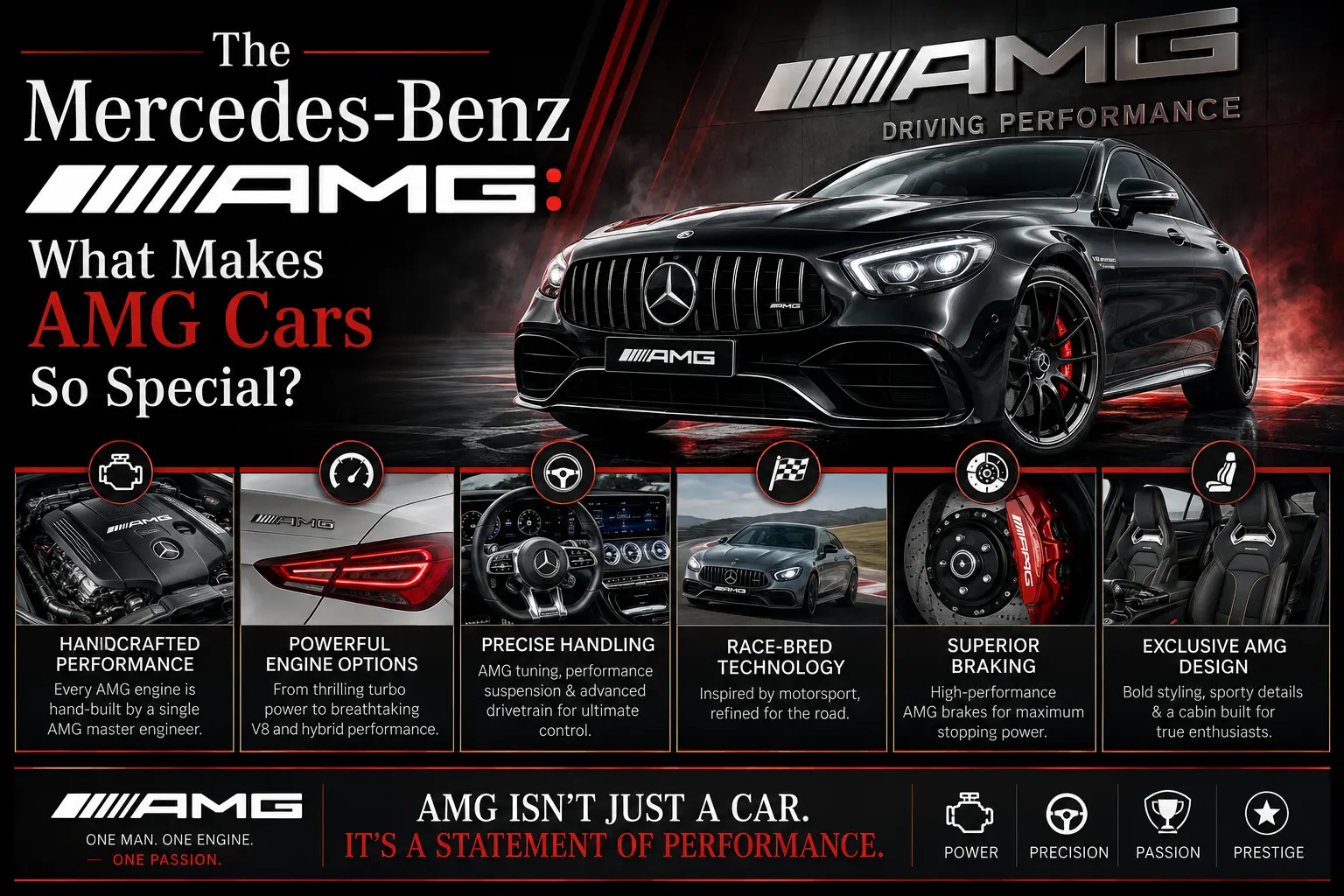
Mercedes-AMG explains that its performance philosophy involves coordinating the entire drivetrain and chassis rather than concentrating on engine output alone. Technologies such as AMG Performance 4MATIC+, AMG RIDE CONTROL suspension, performance steering, and high-performance braking systems are designed to work together.
That is why an AMG can feel different even when you are not driving at extreme speeds.
The AMG Engine: The Heart of the Experience
For many enthusiasts, the engine remains the defining feature.
AMG has a long history of developing high-performance engines, and Affalterbach remains home to AMG’s engine manufacturing operation. Mercedes-AMG currently states that its V8 and four-cylinder/in-line engines are produced there using its “One Man, One Engine” philosophy, with each engine assembled by a single engine builder and carrying that builder’s signed identification plaque.
That approach gives the engine more than impressive specifications. It adds a human element to the manufacturing process.
Performance Is More Than Horsepower
When you evaluate an AMG, you should look beyond the horsepower figure.
Pay attention to:
- Torque delivery
- Throttle response
- Transmission behavior
- Cooling
- Weight
- Traction
- Suspension setup
- Braking performance
For example, modern AMG technology can combine combustion engines with electric assistance. The current C 63 S E PERFORMANCE uses a four-cylinder engine with an electric motor and AMG’s fully variable 4MATIC+ all-wheel drive, demonstrating how AMG performance is evolving beyond traditional large-displacement engines.
AMG Performance Technology
A major reason Mercedes-Benz AMG cars feel special is the technology underneath them.
AMG 4MATIC+ All-Wheel Drive
Depending on the model, AMG’s performance-oriented all-wheel-drive systems are designed to distribute power effectively while maintaining traction and agility.
This matters when you accelerate hard or drive through corners because the drivetrain needs to translate engine output into usable movement rather than simply producing impressive numbers.
AMG RIDE CONTROL Suspension
AMG’s adaptive suspension technology can alter the vehicle’s behavior according to the selected driving mode.
You can have a more relaxed setup for everyday driving and a sharper response when you want to enjoy the car’s performance.
Rear-Axle Steering
Some AMG models use rear-axle steering to improve maneuverability at lower speeds while helping stability and response at higher speeds.
The result is a vehicle that can feel easier to place on the road without sacrificing high-speed confidence.
Mercedes-AMG Driving Modes
One of the enjoyable aspects of an AMG is that you do not necessarily have to drive it aggressively all the time.
Comfort Mode
For your daily commute, Comfort can provide a more relaxed character.
It is useful when you are:
- Driving through traffic
- Commuting to work
- Carrying passengers
- Taking a long trip
Sport and Sport+ Modes
When you want more involvement, performance modes can sharpen responses from the engine, transmission, suspension, and other systems depending on the model.
RACE Mode
Certain AMG models offer a RACE mode designed specifically for controlled performance driving. You should only use track-focused settings in appropriate legal environments and conditions.
AMG Design: You Should See the Performance
An AMG should not only perform differently. It should look the part.
Depending on the model, AMG styling can include:
- Distinctive grille designs
- Larger air openings
- AMG wheels
- Sportier bumpers
- Side skirts
- Performance-oriented rear treatment
- AMG-specific exhaust designs
The design serves an emotional purpose, too. You can often recognize an AMG before seeing the badge.
AMG Interior: Luxury With a Performance Focus
Inside, you still get the premium environment associated with Mercedes-Benz, but AMG adds its own character.
You may find:
- AMG sport seats
- Performance steering wheels
- Aluminum or carbon-fiber-style trim
- AMG displays
- Performance data
- G-force information
- Lap-timing functions on applicable models
The current AMG SL, for example, combines a luxury interior with performance-focused equipment and a 2+2 layout.
AMG vs. Regular Mercedes-Benz
It is useful to understand the difference before you shop.
| Feature | Standard Mercedes-Benz | Mercedes-AMG |
|---|---|---|
| Main focus | Luxury and everyday comfort | Luxury and performance |
| Powertrain | Model-specific | AMG performance calibration |
| Suspension | Comfort-oriented | Performance-oriented |
| Brakes | Standard model system | Performance system where applicable |
| Styling | Mercedes-Benz design | AMG-specific design |
| Driving modes | Model-dependent | Expanded performance settings on many models |
| Price | Generally lower | Generally higher |
| Running costs | Typically easier to manage | Can be higher |
The important point is that AMG is not simply a horsepower upgrade. The engineering philosophy extends to the drivetrain, chassis, brakes, steering, sound, and aerodynamics.
AMG Line vs. Full Mercedes-AMG
This is one of the biggest mistakes new buyers make.
An AMG Line vehicle can have sporty styling and interior features inspired by AMG. That does not automatically make it a full Mercedes-AMG performance model.
If you are shopping for an AMG, check the exact model designation and specifications rather than relying only on an AMG badge or appearance package.
A genuine Mercedes-AMG model receives deeper performance engineering across its powertrain and chassis.
Which Mercedes-AMG Models Can You Choose?
The current AMG range covers a surprisingly broad selection of vehicles. Mercedes-AMG’s official vehicle catalog includes performance versions associated with the C-Class, E-Class, G-Class, GLA, GLC, GLE, GLS, GT, SL, EQE and other model families, with availability varying by market.
Some of the most recognizable examples include:
- Mercedes-AMG C-Class — compact performance luxury
- Mercedes-AMG GT — sports-car-focused performance
- Mercedes-AMG G 63 — iconic SUV presence with extreme performance
- Mercedes-AMG GLC/GLE — performance SUVs
- Mercedes-AMG SL — luxury roadster performance
- Mercedes-AMG GT 4-Door Coupé — performance with greater practicality
Model availability and specifications change, so you should verify the current lineup in your market before making a buying decision.
AMG’s Motorsport Heritage
AMG’s performance identity is closely connected to motorsport.
One of its most famous early achievements came in 1971 when the Mercedes-Benz 300 SEL 6.8 AMG achieved a class victory and finished second overall at the 24 Hours of Spa. AMG’s later history includes DTM and customer racing programs, while the brand has also been involved with Formula 1.
That history helps explain why AMG places such emphasis on handling, braking, power delivery, and driver involvement.
However, you should not assume every component in a road-going AMG is directly taken from a racing car. Motorsport influence is better understood as part of AMG’s engineering culture.
Are Mercedes-AMG Cars Worth the Extra Money?
That depends on what you want from your car.
An AMG can make sense if you value:
- Strong acceleration
- Sharper handling
- Performance technology
- Distinctive styling
- Luxury combined with performance
- An engaging driving experience
A standard Mercedes-Benz may be the better choice if your priorities are:
- Maximum comfort
- Lower purchase cost
- Lower running expenses
- Fuel efficiency
- Relaxed everyday driving
You should also budget for potentially higher costs associated with performance tires, brakes, fuel, insurance, and specialized components.
Frequently Asked Questions About Mercedes-Benz AMG
What makes Mercedes-Benz AMG cars so special?
AMG combines Mercedes-Benz luxury with specialized performance engineering. The engine is only one part of the equation; suspension, brakes, steering, drivetrain, software, sound, and design all contribute to the experience.
What does AMG mean on a Mercedes-Benz?
AMG comes from the names and origins associated with the company’s founders, Hans Werner Aufrecht and Erhard Melcher, with the “G” referring to Großaspach, Aufrecht’s birthplace.
Is AMG better than a regular Mercedes-Benz?
Neither is automatically better. If you want performance and sharper driving dynamics, AMG may suit you better. If you prioritize comfort and everyday efficiency, a standard Mercedes-Benz may be more appropriate.
What is the difference between AMG and AMG Line?
AMG Line generally refers to sportier styling or equipment. A genuine Mercedes-AMG model receives substantially more extensive performance engineering.
Are Mercedes-AMG cars expensive to maintain?
They can be more expensive to maintain than comparable standard models because performance components such as tires, brakes, and specialized drivetrain parts may cost more.
Are Mercedes-AMG cars good for daily driving?
Yes. Many AMG models are designed to combine everyday usability with high performance. Your ideal choice depends on the specific model, suspension setup, body style, and how you drive.
Final Thoughts: Why Mercedes-Benz AMG Remains Special
The magic of Mercedes-Benz AMG does not come from one impressive specification. It comes from how the pieces fit together.
You get a powerful and carefully developed drivetrain, a performance-focused chassis, serious braking capability, distinctive styling, advanced technology, and a connection to decades of motorsport and engineering history.
That is what makes an AMG different.
If you are considering one, do not stop at the badge or horsepower figure. Compare the exact model, equipment, running costs, and driving character with the standard Mercedes-Benz alternatives.
Ready to experience AMG for yourself? Compare your favorite Mercedes-AMG model with its standard Mercedes-Benz counterpart, then arrange a proper test drive. Pay attention to the steering, braking, throttle response, suspension, and sound—not just the numbers on the specification sheet. That is where you will discover what makes AMG genuinely special.