C-Class vs E-Class: Which Mercedes-Benz Sedan Should You Choose in 2026?
Choosing a Mercedes-Benz is exciting—until you find yourself comparing two models that seem surprisingly similar. If you’re stuck between the Mercedes-Benz C-Class vs E-Class, you’re looking at two excellent luxury sedans, but they are designed for slightly different buyers.
The C-Class gives you a more compact, agile package with plenty of premium technology. The E-Class moves further into executive luxury, offering more space, comfort, and sophistication. So, which one deserves a place in your driveway?
The answer depends on how you drive, what you expect from your luxury car, and how much you’re willing to spend. Let’s break down the differences so you can make a confident decision.
C-Class vs E-Class: Quick Comparison
| Category | Mercedes-Benz C-Class | Mercedes-Benz E-Class |
|---|---|---|
| Position | Compact luxury sedan | Midsize luxury sedan |
| Best for | City driving and everyday use | Comfort and long-distance travel |
| Interior | Premium and modern | More spacious and upscale |
| Driving feel | Agile and sporty | Smooth and refined |
| Passenger space | Good | More generous |
| Technology | Advanced | More extensive |
| Price | Generally lower | Generally higher |
| Ideal buyer | First-time luxury buyer | Luxury-focused buyer |
The exact equipment, pricing, and powertrain choices can vary by market and trim, so check the current specifications for the exact 2026 model you’re considering.
Mercedes-Benz C-Class vs E-Class: What’s the Difference?
At first glance, the C-Class and E-Class share plenty of Mercedes-Benz DNA. Both feature elegant styling, premium cabins, advanced infotainment, and a strong focus on comfort.
The biggest difference is positioning and size.
The C-Class is the compact option. It’s easier to maneuver, easier to park, and generally costs less to enter the Mercedes-Benz sedan range.
The E-Class sits higher in the lineup. You get a larger body, more cabin space, a greater emphasis on comfort, and access to additional luxury technology depending on the configuration.
Think of the C-Class as the Mercedes-Benz sedan for drivers who want luxury with a sporty, manageable footprint. The E-Class is aimed more toward drivers who want a spacious and sophisticated cruiser.
C-Class: Compact Luxury With a Sportier Feel
The C-Class makes a lot of sense if your daily routine includes city streets, crowded parking garages, and frequent commuting.
Why You Might Prefer the C-Class
- More compact dimensions
- Easier urban maneuverability
- Sportier driving character
- Premium interior
- Advanced digital technology
- Lower starting price than the E-Class
If you don’t regularly carry several adult passengers, the C-Class can give you everything you need without paying for additional size you may rarely use.
E-Class: More Space and Greater Refinement
The E-Class is the better match if you want your sedan to feel more substantial.
You get additional interior room and a driving experience designed around relaxed cruising. That difference becomes particularly noticeable when you’re spending hours on the highway.
Why You Might Prefer the E-Class
- More passenger space
- Greater rear-seat comfort
- More sophisticated cabin
- Strong long-distance credentials
- More advanced available technology
- Higher level of overall refinement
If you frequently carry passengers or take long road trips, the E-Class becomes much easier to justify.
C-Class vs E-Class: Interior and Comfort
Your daily experience inside the vehicle matters just as much as horsepower.
The C-Class interior has a modern, driver-focused character. Its digital displays and available premium materials make it feel considerably more upscale than the word “compact” might suggest.
The E-Class, meanwhile, takes that concept further. Its larger cabin gives designers more room to create an environment focused on comfort and technology.
C-Class Interior Advantages
- Sportier atmosphere
- High-quality materials
- Comfortable front seats
- Modern infotainment
- Easy-to-manage cabin size
E-Class Interior Advantages
- More spacious passenger area
- Greater rear-seat comfort
- More premium atmosphere
- More available luxury equipment
- Excellent environment for long journeys
If you spend most of your time driving alone, the C-Class may feel like enough. If you often have passengers, the E-Class’s extra room becomes much more valuable.
C-Class vs E-Class: Technology and Infotainment
Both cars can give you a highly digital driving experience, but the E-Class is positioned to offer a more extensive technology package.
Depending on trim and options, you can find features such as:
- Mercedes-Benz MBUX infotainment
- Digital instrument displays
- Smartphone integration
- Voice controls
- Navigation
- Parking assistance
- Driver-assistance technology
- Surround-view camera systems
The important point is to compare specific trims, not simply the model names.
A well-equipped C-Class can have more technology than a lower-trim E-Class. Before buying, check exactly which features are standard and which require an optional package.
C-Class vs E-Class: Performance and Driving Experience
If you enjoy driving, this is where the two cars begin to feel noticeably different.
C-Class Driving Experience
The smaller dimensions give the C-Class an agile character. You can place the car easily on narrow streets, maneuver through parking lots, and enjoy a more responsive feel.
It’s a particularly appealing option if you want your luxury sedan to retain some sportiness.
E-Class Driving Experience
The E-Class puts greater emphasis on smoothness and composure. Its larger size and luxury-oriented setup make it particularly attractive for highway driving.
You should also consider the specific powertrain. Horsepower, torque, acceleration, drivetrain, and suspension equipment can vary significantly between configurations.
Which Is Faster?
Don’t assume that the E-Class or C-Class is automatically faster. Compare the exact versions you’re considering.
For a proper comparison, look at:
- Horsepower
- Torque
- 0–60 mph time
- Drivetrain
- Transmission
- Curb weight
If performance is your priority, also explore Mercedes-AMG versions rather than comparing only the standard models.
C-Class vs E-Class: Fuel Economy and Hybrid Options
Fuel efficiency can make a meaningful difference to your ownership costs.
Your choice should depend on the exact engine and drivetrain rather than simply choosing one model over the other.
When comparing fuel economy, consider:
- EPA-rated fuel economy
- Engine type
- Hybrid technology
- All-wheel drive
- Wheel and tire configuration
- Your typical driving conditions
If you drive mostly in the city, an electrified powertrain may offer different benefits than it would for someone who spends most of the week on highways.
Always check current EPA figures and Mercedes-Benz specifications for your exact model and market.
C-Class vs E-Class: Safety Features
Both Mercedes-Benz sedans can offer an extensive range of safety and driver-assistance technologies.
Depending on the configuration, you may find:
- Automatic emergency braking
- Blind-spot monitoring
- Lane-keeping assistance
- Adaptive cruise control
- Parking assistance
- Collision warning
- Surround-view cameras
When safety is important to you, don’t rely solely on a feature list. Check current IIHS and NHTSA ratings for the exact model year you’re considering.
C-Class vs E-Class: Pricing and Ownership Costs
The C-Class generally has the advantage if your primary concern is purchase price.
However, don’t stop at MSRP.
Your real ownership budget should include:
- Insurance
- Fuel
- Maintenance
- Tires
- Repairs
- Financing
- Registration
- Depreciation
The E-Class costs more because it occupies a higher position in the lineup, but that doesn’t automatically make it poor value.
If you’ll regularly use the additional space and luxury features, paying more could make sense. If you mostly commute alone, the C-Class may give you the Mercedes-Benz experience you want without unnecessary expense.
Which Is Better for Families?
If you frequently carry family members, the E-Class has a natural advantage because of its larger dimensions and more generous passenger space.
Choose the C-Class if you:
- Usually drive alone
- Have a smaller family
- Spend a lot of time in the city
- Want easier parking
- Prefer a sportier feel
- Want to keep your purchase budget lower
Choose the E-Class if you:
- Frequently carry adults
- Take family road trips
- Want greater rear-seat comfort
- Prefer a smoother ride
- Want a more spacious cabin
C-Class vs E-Class: Pros and Cons
C-Class Pros
- Compact dimensions
- Sporty driving feel
- Premium interior
- Lower entry price
- Strong technology
C-Class Cons
- Less rear-seat space
- Smaller cargo area
- Some desirable features may require options
E-Class Pros
- Larger cabin
- Excellent ride comfort
- More upscale atmosphere
- Advanced available technology
- Better suited to long journeys
E-Class Cons
- Higher purchase price
- Larger footprint
- Potentially higher ownership costs
C-Class vs E-Class: Which One Should You Choose?
Here’s the simplest way to make the decision.
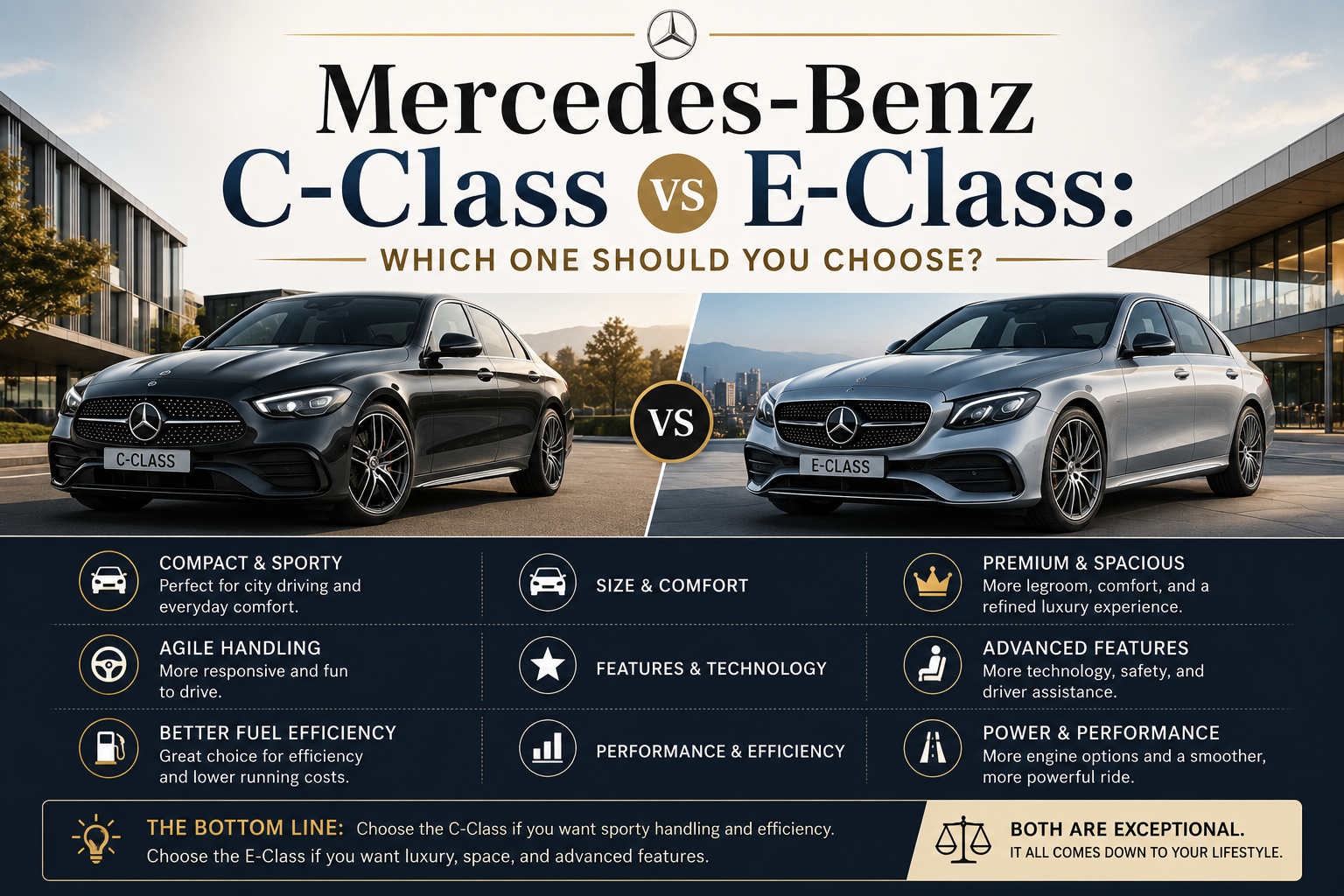
Choose the C-Class if you want compact luxury, agile handling, modern technology, and a more accessible price.
Choose the E-Class if you want more space, greater comfort, a more sophisticated interior, and a stronger long-distance driving experience.
Neither is automatically the “better” Mercedes-Benz. The better choice is the one that matches your actual lifestyle.
Frequently Asked Questions About C-Class vs E-Class
Is the C-Class or E-Class better?
The C-Class is ideal if you prefer a smaller, sportier sedan, while the E-Class is better suited to buyers who prioritize space, comfort, and refinement.
Is C-Class vs E-Class a big difference?
Yes. The E-Class is larger and positioned higher in the Mercedes-Benz lineup, while the C-Class focuses on compact luxury and agility.
Which is more luxurious, C-Class or E-Class?
The E-Class generally offers a more spacious and upscale experience, particularly when comparing similarly equipped vehicles.
Which is cheaper, C-Class or E-Class?
The C-Class generally has the lower starting price, although the final cost depends on trim, options, powertrain, and market.
Which has more space, C-Class or E-Class?
The E-Class is the larger vehicle and generally provides more passenger room. Check the official specifications for the exact model year and market.
Which is better for long-distance driving?
The E-Class is usually the stronger choice if you value highway comfort, additional passenger space, and a relaxed driving experience.
Which is better for city driving?
The C-Class can be easier to live with in urban environments because its smaller footprint makes parking and maneuvering simpler.
Conclusion: C-Class vs E-Class — Make the Choice That Fits You
The Mercedes-Benz C-Class vs E-Class debate comes down to one question: what do you want from your luxury sedan?
If you want something compact, agile, stylish, and easier on your budget, the C-Class is a compelling choice. If you want more space, comfort, technology, and a stronger long-distance character, the E-Class is worth the extra investment.
Before you make your final decision, compare the exact trims, check the included equipment, calculate your expected ownership costs, and test-drive both models back-to-back.
Your perfect Mercedes-Benz isn’t necessarily the larger or more expensive one. It’s the one that fits your roads, your passengers, your budget, and your lifestyle.
Which would you choose—the C-Class or E-Class? Leave a comment with your pick and tell us what matters most to you: price, performance, comfort, technology, or luxury.