BMW M Cars: What Makes BMW M So Special in 2026?
There are fast cars, and then there are cars that make you look forward to the next drive. BMW M Cars belong firmly in the second category. From the moment you press the start button, the experience is about more than horsepower. Steering response, braking, chassis balance, acceleration, and the sound of the engine all work together to make you feel involved.
But what actually makes BMW M so different from a regular BMW?
The answer goes back to motorsport. BMW M was founded in 1972 as BMW Motorsport GmbH, and the company still describes motorsport as part of its DNA. Its road cars are designed to bring that performance philosophy into everyday driving. (BMW M)
What Is BMW M?
BMW M is BMW’s high-performance division, created around the idea of transferring motorsport knowledge to road-going cars.
The company’s history includes legendary machines such as the BMW 3.0 CSL, BMW M1, M3, and M5. BMW says its goal for M automobiles is to capture the fascination of motorsport in cars suitable for everyday use. (BMW M)
That philosophy helps explain why an M car is not simply a BMW with a more powerful engine.
You get a broader package that can include:
- High-performance engines
- M-specific suspension tuning
- Larger performance brakes
- Specialized cooling systems
- Aerodynamic improvements
- Performance-oriented electronics
- M-specific driving modes
- Motorsport-inspired interior details
BMW M Cars vs Regular BMW Models
One of the easiest mistakes you can make when shopping for a BMW is assuming that every vehicle carrying an M badge is a full M car.
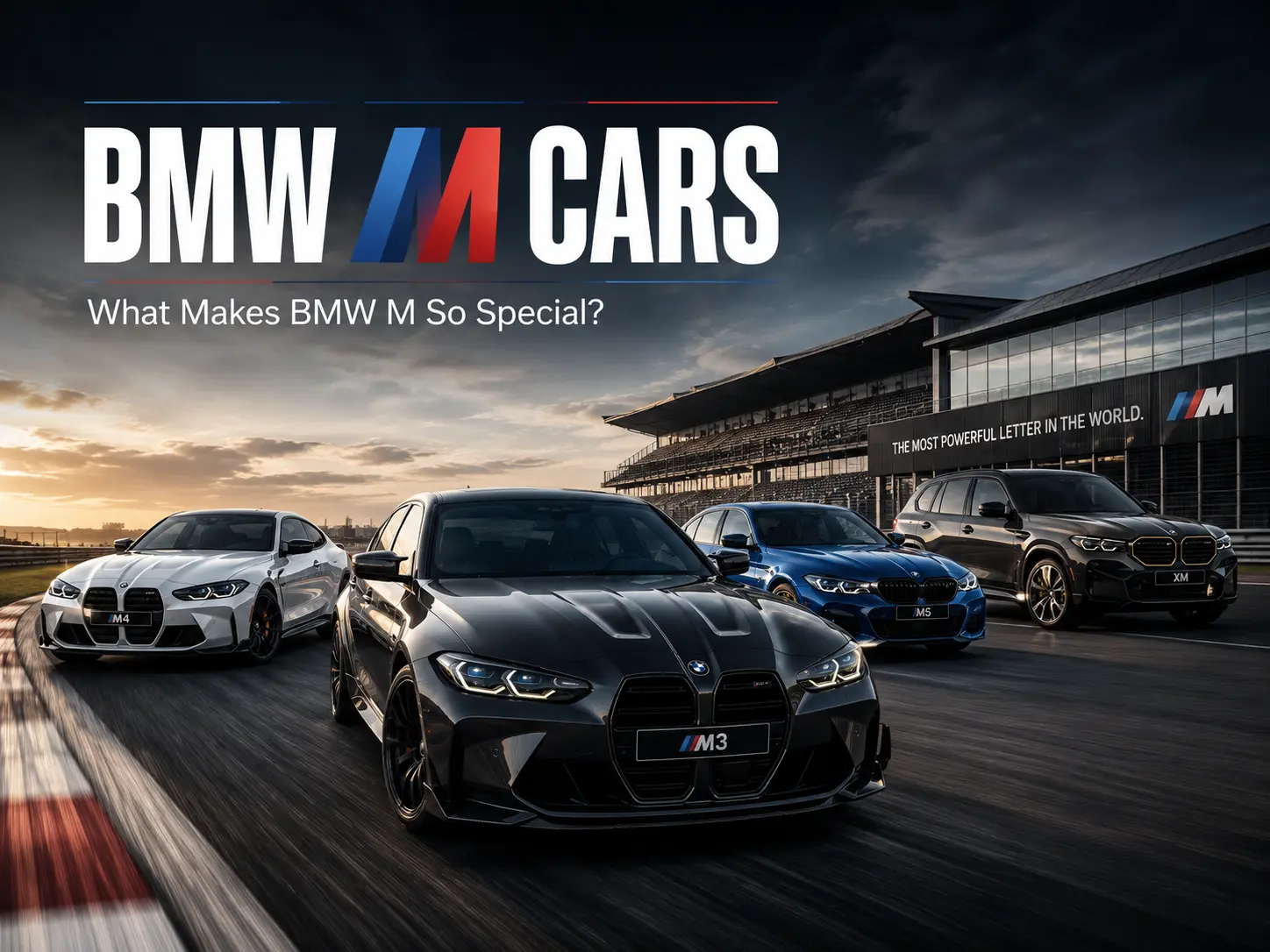
BMW’s lineup includes M Performance automobiles as well as full BMW M high-performance models. The official BMW M lineup currently includes vehicles such as the M2, M3, M4, M5, XM, and high-performance X models, alongside M Performance vehicles. (BMW M)
What Does the M Badge Mean?
You should look carefully at the model designation.
For example, an M Sport package can primarily add styling and equipment, while an M Performance model sits higher in performance. A full M automobile receives substantially more extensive performance engineering.
That distinction matters if you’re specifically looking for the authentic BMW M driving experience.
What Makes BMW M Cars So Powerful?
High-Performance BMW M Engines
Engine performance is obviously central to the M experience, but BMW’s approach goes beyond simply increasing output.
Depending on the model, BMW M uses highly developed turbocharged engines and performance-oriented powertrain technology. The engineering focus includes power delivery, cooling, lubrication, durability, and electronic control.
When comparing BMW M Cars, look beyond horsepower alone. You should also consider:
- Torque delivery
- Acceleration
- Transmission response
- Cooling capacity
- Engine character
- Power-to-weight ratio
A car with huge horsepower numbers isn’t automatically more enjoyable. The way that power reaches the road can matter just as much.
M-Tuned Suspension and Handling
This is where the difference can become obvious when you drive an M car.
BMW M engineers tune the suspension, steering, chassis, and electronic systems to work together. Depending on the model, you may have adaptive suspension and selectable driving settings that allow you to change the vehicle’s behavior.
You can therefore move between a more relaxed setup for everyday driving and a sharper configuration when you want to explore the car’s performance.
Why BMW M Cars Feel Different
The important point is integration.
The engine, transmission, suspension, steering, brakes, tires, and stability systems aren’t developed as isolated components. Their combined behavior is what creates the M character.
BMW M Cars: Brakes and Performance Control
A powerful engine is only useful if you can control the car effectively.
BMW M models use high-performance braking systems designed to cope with demanding driving. Depending on the vehicle, available equipment can include upgraded brake systems and carbon-ceramic brakes.
You should also pay attention to electronic performance systems.
Depending on the model, BMW M technology can include:
- Adjustable traction control
- Launch control
- Configurable driving modes
- Performance displays
- M-specific stability settings
These systems allow you to tailor the car to your preferences instead of having only one fixed driving personality.
BMW M xDrive vs Rear-Wheel Drive
BMW’s traditional performance identity has long been associated with rear-wheel drive, but modern M cars increasingly use sophisticated all-wheel-drive systems.
What Is M xDrive?
M xDrive is BMW’s performance-focused all-wheel-drive technology. It can provide additional traction when you accelerate aggressively or encounter less-than-ideal road conditions.
For you, that can mean greater confidence when putting substantial power down.
Rear-wheel-drive M cars, meanwhile, preserve a more traditional enthusiast-oriented experience. They can offer a strong sense of interaction between your throttle inputs and the car’s behavior.
Which Should You Choose?
M xDrive makes sense if you want:
- Strong traction
- Rapid acceleration
- Additional confidence in changing conditions
- Everyday usability
Rear-wheel drive may appeal to you if you want:
- Traditional BMW performance character
- Greater emphasis on driver involvement
- A more classic enthusiast experience
Neither system is automatically better. Your priorities should determine the choice.
BMW M Cars and Aerodynamics
The aggressive appearance of an M car isn’t purely cosmetic.
Large air intakes can support cooling, while spoilers, diffusers, splitters, and other aerodynamic elements can influence stability and airflow.
BMW’s M heritage has repeatedly emphasized lightweight construction and aerodynamics. The historic 3.0 CSL, for example, combined lightweight engineering, motorsport development, and aerodynamic design. (BMW M)
So when you see an M car with wider bodywork or aggressive aerodynamic details, some of those changes have a functional purpose.
The Most Iconic BMW M Cars
BMW M1
The M1 occupies a special place in BMW history. Introduced in 1978, it was the first model developed entirely in-house by BMW M GmbH and used a mid-engine layout. BMW produced only around 400 road cars, making it exceptionally rare. (BMW M)
BMW M3
The M3 may be the name most closely associated with BMW M.
The first E30 M3 arrived in 1986 and was developed with motorsport firmly in mind. BMW’s history records six generations of the M3, with the model celebrating its 40th anniversary in 2026. (BMW M)
BMW M5
The M5 helped establish the idea that a luxury sedan could also deliver serious sports-car performance. The first M5 arrived in the 1980s, creating a formula that remains central to the model today. (BMW M)
BMW M Cars in 2026
BMW’s current M family is broader than it was during the brand’s early years.
The official lineup includes models such as:
- BMW M2
- BMW M3
- BMW M4
- BMW M5
- BMW XM
- X5 M
- X6 M
- M Performance models
BMW is also moving deeper into electrification. Its 2026 technology work includes an upcoming high-performance electric M architecture using four electric motors and M Dynamic Performance Control. (BMW M)
That means the future of BMW M won’t necessarily be defined only by combustion engines. BMW is attempting to transfer the M philosophy into electric performance as well.
BMW M Cars: Interior and Technology
Inside an M car, the performance theme continues.
Depending on the model and specification, you can find:
- M-specific seats
- M steering wheels
- Carbon-fiber trim
- Performance displays
- Configurable driving modes
- M-specific controls
- Advanced infotainment
The technology isn’t there simply to make the cabin look futuristic. Performance-oriented controls can allow you to configure how the engine, transmission, steering, suspension, and traction systems behave.
That gives you considerably more control over the character of the vehicle.
Are BMW M Cars Practical for Daily Driving?
This is one of the biggest advantages of the M philosophy.
BMW’s stated goal is to combine motorsport fascination with everyday usability. (BMW M)
You can therefore use many M models for commuting, shopping, highway trips, and everyday errands.
However, you should expect higher running costs.
Your budget should account for:
- Premium performance tires
- Brake replacement
- Fuel consumption
- Insurance
- Scheduled maintenance
- Potential repairs
A full M car may also feel firmer and more aggressive than a standard BMW, depending on the model and selected driving mode.
Are BMW M Cars Worth the Money?
An M car makes the most sense if you genuinely value performance.
You should consider one if you:
- Enjoy spirited driving.
- Want exceptional acceleration and handling.
- Appreciate motorsport engineering.
- Want a performance car that can still be used regularly.
- Plan to attend occasional track events.
A standard BMW or M Performance model may make more sense if you primarily commute through traffic and want lower operating costs.
BMW M Cars: Quick Comparison
| Feature | BMW M Cars |
|---|---|
| Primary Purpose | High-performance driving |
| Engineering | Motorsport-inspired |
| Engines | High-output performance powertrains |
| Suspension | M-specific tuning |
| Brakes | High-performance systems |
| Drivetrain | RWD or M xDrive depending on model |
| Technology | Advanced performance controls |
| Daily Usability | Depends on model |
| Running Costs | Generally higher |
| Ideal Buyer | Performance enthusiast |
FAQ About BMW M Cars
What makes BMW M Cars special?
BMW M Cars combine motorsport heritage with road-car usability. Their engines, suspension, brakes, aerodynamics, electronics, and driving systems are developed to deliver a more focused performance experience.
What does BMW M stand for?
BMW M grew from BMW Motorsport GmbH, which was founded in 1972. Motorsport remains a central part of the brand’s identity. (BMW M)
Are BMW M Cars reliable?
Reliability varies significantly by model, generation, powertrain, mileage, maintenance history, and how the vehicle has been driven. You should research the specific model and generation rather than assuming every M car has the same reliability.
What is the best BMW M Car for daily driving?
That depends on what you need. The M3 and M5 can combine substantial performance with four-door practicality, while the M2 offers a more compact performance-car experience. Your choice should depend on passenger space, comfort, performance, and budget.
Are BMW M Cars expensive to maintain?
They can cost more to maintain than standard BMW models because performance tires, brakes, fluids, and specialized components can be more expensive.
What is the difference between BMW M and M Performance?
A full BMW M model receives extensive performance engineering, while M Performance vehicles sit between conventional BMW models and full M cars. Always check the exact model designation rather than relying only on the M badge.
Conclusion: What Really Makes BMW M Cars Special?
The magic of BMW M Cars isn’t found in one specification.
It’s the combination of motorsport heritage, engine performance, chassis development, braking capability, aerodynamics, electronics, and driver involvement. BMW M began with racing in mind, and that heritage continues to influence its road cars decades later. (BMW M)
The lineup has also evolved. Today’s M family includes compact performance cars, luxury sedans, SUVs, and increasingly electrified technology. BMW’s current development of four-motor electric M technology shows that the brand intends to carry its performance philosophy into the next generation. (BMW M)
So, if you want a BMW that gives you more than transportation, an M car deserves a closer look.
Which BMW M car is your favorite—the M2, M3, M4, M5, or one of the M SUVs? Share your pick and tell us what matters most to you: power, handling, sound, design, technology, or pure driving enjoyment.